
Optimizing Card Payment Costs in a Payment Gateway
Payments made with certain types of payment cards can be significantly more expensive for merchants than others. This typically applies to business payment cards or cards issued outside the EU, which are not subject to European interchange fee regulation.
To help reduce and better control card payment costs, we offer two solutions that merchants can choose from depending on their business model.


Why are payments with some card types more expensive?
Fees for payments made with cards issued to private individuals by banks based in the EU are regulated. The European Union has introduced caps on interchange fees for so-called regulated cards, i.e. cards issued to consumers.
Business cards and cards issued outside the EU, however, are not subject to this regulation. Fees for these card types can therefore be significantly higher, resulting in substantial differences in transaction costs.
Available Solutions

Passing on the Fee (Surcharge)
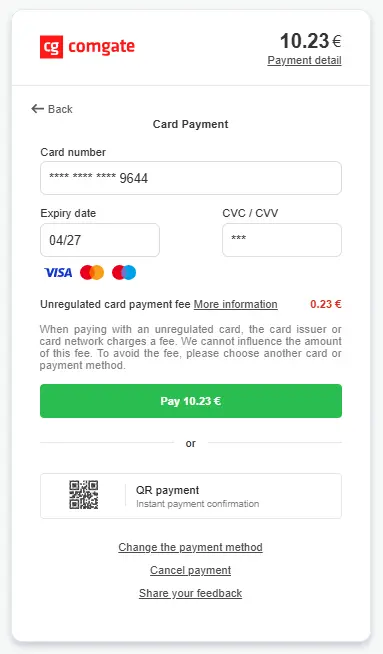
This feature allows merchants to pass part of the transaction fee for non-regulated payment cards to the payer (customer). As a result, the merchant only pays a fee equivalent to a regulated consumer card, regardless of the card type used by the customer.
During the card payment process, the payment gateway identifies a non-regulated card type and informs the customer about the surcharge. The customer can then decide whether to continue with the surcharge or choose a different payment method (e.g. QR payment or a consumer card issued within the EU).
Benefits of this solution:
predictable card payment costs
stable margins regardless of the card type used
maximum availability of payment methods
More information about this service can be found on our support pages.

Acceptance of Selected Payment Cards
This feature allows merchants to adjust the acceptance of selected payment card types where permitted under card scheme rules. For example, merchants may choose not to accept certain card types associated with higher transaction fees.
Within the payment gateway, customers are transparently informed that a particular card type cannot be used and are offered the option to choose another payment method or a different card.
Benefits of this solution:
elimination of high-fee transactions
simple setup without additional implementation
full control over the structure of accepted payments
More information about this service can be found on our support pages.


Apple Pay and Google Pay
When using Apple Pay or Google Pay, the payment gateway does not receive information about the payment card type in real time.
Merchants therefore have two options:
Disable Apple Pay and Google Pay payments.
Allow Apple Pay and Google Pay, acknowledging that surcharges or card-type restrictions may not always be applicable to these payments.
Which solution is right for you?
Passing fees to the payer (surcharge) is suitable for merchants who want to maintain maximum payment flexibility while ensuring stable and predictable costs.
Acceptance of selected payment cards is suitable for merchants who prefer a simple setup and strict cost control, even if it means adjusting the availability of certain card types.